Is 14 Characters Too Many for Fantasy? The Perfect Cast Size Guide
 Jun, 16 2026
Fantasy Cast Size & Cognitive Load Calculator
Enter your cast details below to analyze the potential "Cognitive Load" for your readers. This tool helps determine if your character count is manageable or if you risk overwhelming your audience.
Analysis Result
- POV Ratio: --
- Structure Factor: --
- Est. Reader Fatigue: --
You’ve spent months building your world. You have the magic system mapped out, the political factions defined, and the ancient prophecy written in blood. But then you hit a wall. You look at your character list and see fourteen names staring back at you. Suddenly, the epic scope feels less like an adventure and more like a logistical nightmare. Is fourteen people too many for a fantasy novel?
The short answer is no. Fourteen is not inherently too many. But it is dangerously close to the edge where reader engagement starts to slip through the cracks. In fantasy, specifically, we are asking readers to memorize names that don’t exist in real life, track complex family trees, and understand rules of physics that defy reality. Adding a crowded cast amplifies every one of those challenges.
Let’s break down why this number feels heavy, when it actually works, and how to manage a large cast without losing your audience.
The Cognitive Load of Fantasy Readers
Fantasy is unique among genres because it demands a higher cognitive load from the reader right from page one. In contemporary fiction, if a character named John walks into a room, the reader knows who John is. In fantasy, if Kaelen Thorne is a rogue elf with a grudge against the Sun King walks into a room, the reader has to pause. They have to file away the name, the race, and the motivation before they can care about his actions.
Psychological studies on working memory suggest that most people can hold about four to seven chunks of information in their active mind at once. When you introduce fourteen distinct characters, you are asking the reader to juggle well beyond that limit. If these characters appear simultaneously, the reader will forget who said what. If they appear sequentially but frequently, the reader will feel overwhelmed by the sheer volume of personalities they need to track.
This isn't just about names. It's about distinct voices. If you have fourteen characters, do you have fourteen distinct ways of speaking? Or do you have three distinct voices repeated across different bodies? The latter is a common trap. Writers often create "archetypes" rather than people. You get the brooding warrior, the wise mage, and the comic relief thief. If you have five warriors, five mages, and four thieves, the reader won't remember fourteen characters. They'll remember three archetypes and get confused by the interchangeable faces attached to them.
POV vs. Supporting Cast: The Real Distinction
To determine if fourteen is too many, you first need to categorize your characters. Not all characters carry the same weight. We usually divide them into two groups: Point of View (POV) characters and supporting cast.
POV Characters are the lenses through which we experience the story. We hear their internal thoughts, fears, and secrets. Having fourteen POV characters is almost always a mistake for a single volume. George R.R. Martin manages multiple POVs in A Song of Ice and Fire, but even he rarely exceeds ten active POVs per book, and many are recurring or minor. If you have fourteen POVs, each gets very little screen time. By the time the reader connects with Character A, you switch to Character B, then C, then D. The emotional arc never builds because the perspective keeps shifting.
Supporting Cast includes everyone else. These are the characters who react to the protagonists. They provide dialogue, conflict, and world-building context. Having fourteen supporting characters is perfectly fine. In fact, it adds realism. A tavern scene with only two people feels staged. A tavern with a dozen background characters feels alive. The key is that the reader doesn't need to know the biography of every supporting character. They just need to recognize them when they reappear.
If your count of fourteen includes six POV characters and eight supporting characters, you are in a healthy zone. If your count of fourteen means fourteen POV characters, you have a structural problem that needs fixing.
When Large Casts Work: The Ensemble Model
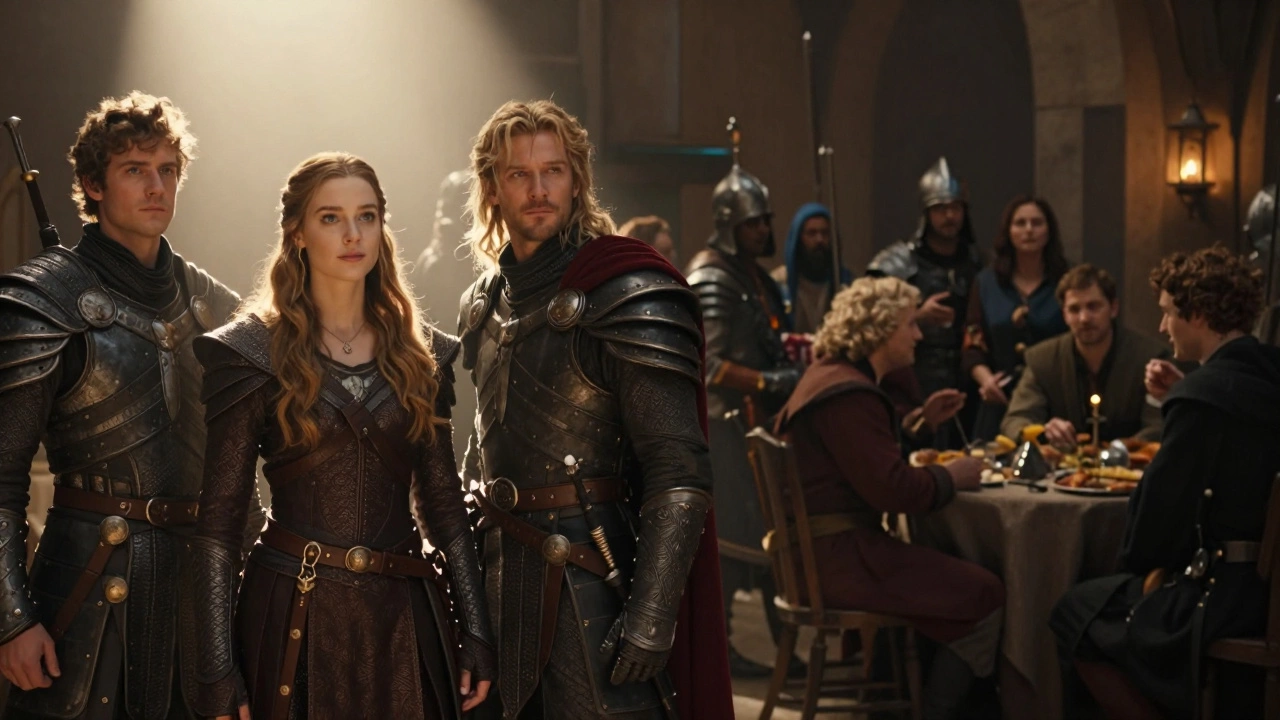
There are scenarios where a large cast is not just acceptable, but necessary. This is often called the "ensemble" model. Think of the Fellowship of the Ring. There are nine members, plus Aragorn, Legolas, Gimli, and various others who join and leave. That’s a lot of people. But Tolkien manages it because the group travels together. They are physically bound in the same space. The reader sees their interactions constantly.
If your fourteen characters are all part of a single military unit, a boarding school, or a ship’s crew, the large cast works. The proximity forces interaction. You don't need to spend pages introducing them individually because they introduce themselves to each other in front of the reader. This is efficient storytelling. It allows you to establish relationships through action rather than exposition.
However, if your fourteen characters are scattered across three continents, involved in separate plotlines that only converge at the climax, you are in trouble. This is the "spaghetti western" structure gone wrong. Without regular interaction, the reader cannot build a mental map of how these characters relate to one another. You end up writing four mini-novels instead of one cohesive epic.
The Danger of Character Bloat
Character bloat happens when writers add characters to solve plot problems rather than to deepen the theme. You need someone to betray the hero? Add a new character. You need someone to explain the magic system? Add a mentor. You need a love interest? Add a romantic lead. Before you know it, you have a bloated roster of functional characters who exist only to move the plot forward.
These characters often lack depth. Because they were added late in the planning stage, they haven't been given backstories, flaws, or arcs. They feel flat. And when you have fourteen such characters, the narrative becomes mechanical. It reads like a checklist: "Hero meets Ally A. Hero fights Enemy B. Hero learns Magic C." The human element gets lost in the logistics.
A better approach is to merge functions. Can the betrayer also be the love interest? Can the mentor also be the comic relief? Merging roles reduces the headcount while increasing complexity. Fewer characters doing more things is almost always stronger than many characters doing one thing each.
Practical Tips for Managing a Large Cast
If you decide to keep your fourteen characters, you need strategies to keep the reader oriented. Here are some practical techniques used by successful fantasy authors:
- Distinct Visual Markers: Give each character a unique visual trait. Not just "tall" or "dark hair," but specific details. One character always wears a red scarf. Another has a scar over their left eye. Another speaks with a lisp. These anchors help the reader distinguish them quickly.
- Group Dynamics: Establish clear hierarchies. Who leads? Who follows? Who clashes with whom? If the reader understands the social dynamic, they don't need to remember every individual detail. They can infer behavior based on role.
- Limited Introduction Windows: Don't introduce all fourteen characters in the first chapter. Introduce them in clusters. Start with three core characters. Once the reader is comfortable, introduce the next three. This pacing prevents cognitive overload.
- Consistent Naming Conventions: Avoid names that sound similar. Kael, Kale, Cale, and Callum will drive readers crazy. Use distinct phonetic structures. Mix short names (Jax) with long names (Seraphina). This creates auditory variety.
- Use Dialogue Tags Wisely: In scenes with many speakers, avoid generic "he said/she said." Use action beats to identify speakers. "Kaelen drew his sword." "Mara laughed." This grounds the dialogue in physical space and helps the reader track who is talking.
Comparison: Small Cast vs. Large Cast
| Feature | Small Cast (3-5) | Large Cast (10-14+) |
|---|---|---|
| Depth of Characterization | High. More word count per character. | Lower. Must prioritize breadth over depth. |
| World-Building Scope | Limited. Often focused on personal stakes. | Broad. Can explore multiple cultures/factions. |
| Reader Memory Load | Low. Easy to track relationships. | High. Risk of confusion and fatigue. |
| Pacing | Slower, more introspective. | Faster, more action-driven. |
| Best For | Intimate dramas, psychological fantasies. | Epic sagas, war stories, ensemble adventures. |
How to Trim Your List
If you’re unsure whether to cut characters, try this exercise. Take your list of fourteen. For each character, write down their primary function in the plot. Now, look for overlaps. Do two characters both serve as the "wise guide"? Do two characters both provide "comic relief"? Merge them. Combine their best traits into one stronger character.
Next, ask yourself: Does this character change? If a character enters the story, does something, and leaves without having changed internally or externally, they might be disposable. Static characters are harder to justify in a large cast because they take up space without adding growth. Prioritize characters who undergo significant transformation.
Finally, consider the protagonist’s journey. Every secondary character should either help or hinder the protagonist’s goal. If a character has no impact on the main plot, they belong in a sequel or a spin-off, not this book. Be ruthless. Your readers will thank you for the clarity.
Conclusion: Quality Over Quantity
Fourteen characters is not too many if they are essential, distinct, and well-integrated. It is too many if they are redundant, vague, or disconnected. The goal of fantasy writing is not to impress the reader with the size of your cast, but to immerse them in a believable world. A smaller cast with deep connections often achieves this better than a larger cast with shallow ones. Focus on making each character indispensable. If you can remove a character and the story still works, remove them. If their absence breaks the plot, keep them. Let necessity, not ambition, dictate your cast size.
How many POV characters are too many in a fantasy novel?
Generally, more than 6-8 POV characters in a single volume is risky. Each POV requires significant word count to develop an emotional connection. Beyond 8, the narrative voice becomes fragmented, and readers struggle to invest in any single character's journey. If you have more, consider grouping them or reducing them to key perspectives.
Can I have 14 main characters in a trilogy?
Yes, absolutely. A trilogy allows you to spread the development of a large cast across three books. Book 1 can focus on 5-6 characters, Book 2 expands to include others, and Book 3 brings them all together. This pacing gives each character adequate space to breathe and grow without overwhelming the reader in a single sitting.
What is character bloat and how do I fix it?
Character bloat occurs when you add characters to solve plot holes rather than to enrich the story. To fix it, identify characters with overlapping roles (e.g., two mentors) and merge them. Remove characters who do not actively influence the protagonist's arc or undergo significant change themselves.
How do I help readers remember many fantasy names?
Use distinct phonetic structures for names (avoid similar sounds). Give each character a unique visual marker or mannerism. Introduce characters in small groups rather than all at once. Consistently use action beats in dialogue to anchor speakers, helping readers associate voices with identities.
Is it better to have fewer characters with more depth?
For most novels, yes. Depth creates emotional resonance. Readers connect with characters who feel real and complex. A small cast allows for richer internal monologues and nuanced relationships. Large casts work best for epic scopes where world-building is the primary draw, but even then, depth in key characters is crucial for engagement.